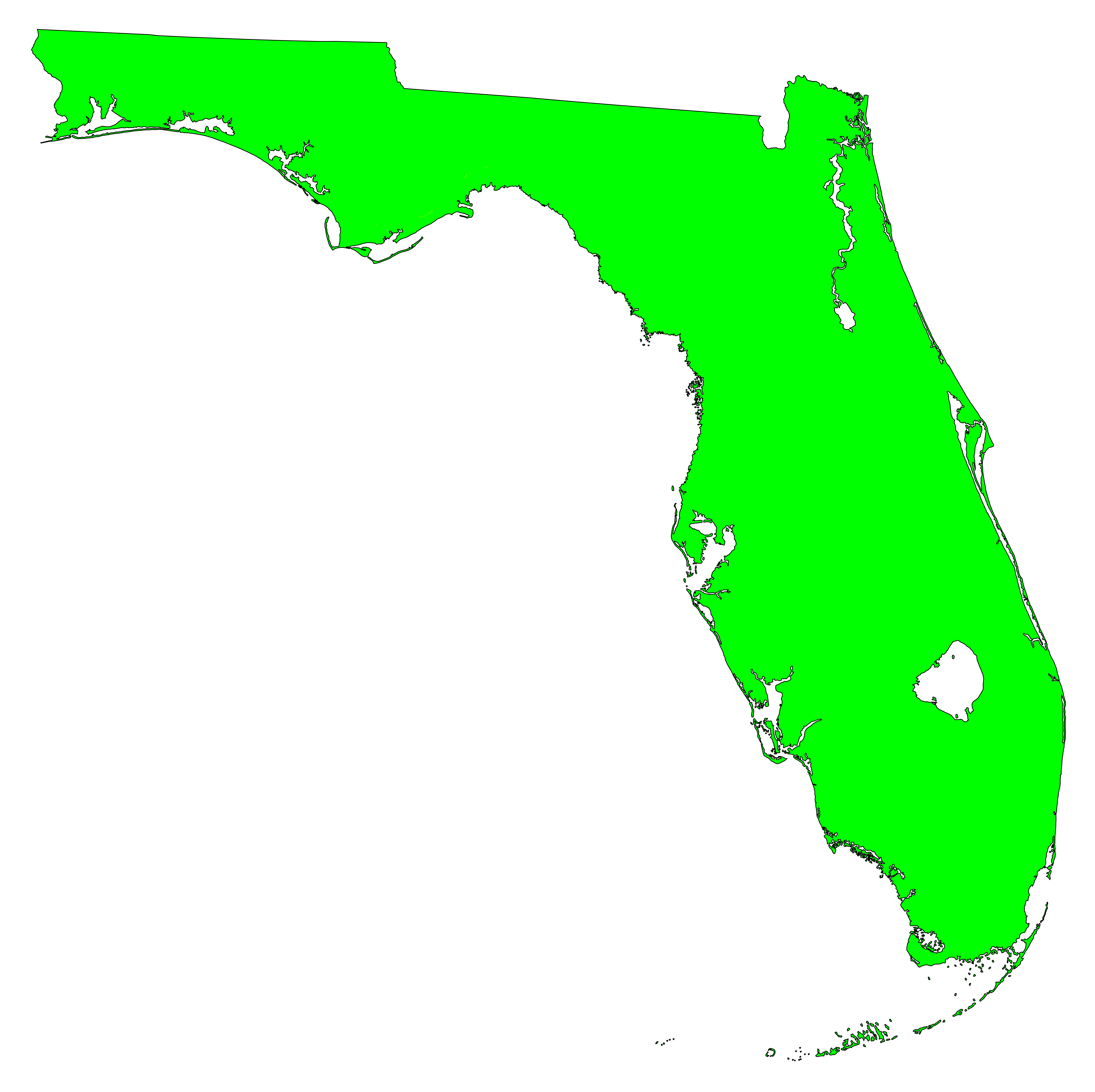



Florida
Florida Negligent Security Law: Statute, Standards & Key Cases
Florida gives you two years to file a negligent security claim. Property owners who fail to protect visitors from foreseeable crime face significant liability — but recent tort reform has changed the rules.
By 411 Press Legal Desk9 min read
A guest is shot in a motel parking lot at 2 a.m. The exterior lights have been dark for weeks. The security camera over the entrance has been broken since last year. Management received three police reports for armed robberies in the same lot over the past 18 months. None of those reports prompted any changes.
The criminal who pulled the trigger will face prosecution. But in Florida, the property owner who allowed those conditions to persist faces a separate legal reckoning: a negligent security claim.
Florida is one of the most active states in the country for negligent security litigation. Its combination of high-traffic commercial properties, a large hospitality industry, and well-developed premises liability case law means courts here see these claims regularly. This guide covers the current law — including critical changes from Florida's 2023 tort reform — so you understand your rights and the deadlines you face.
Statute of Limitations
Two years from the date of the injury. Under Florida Statutes § 95.11(5)(a), you have two years to file a negligent security lawsuit.
This deadline changed recently. Before March 24, 2023, Florida allowed four years for most negligence-based personal injury claims. HB 837, the sweeping tort reform bill signed into law on that date, cut the window in half. If your injury occurred before March 24, 2023, the four-year deadline still applies. For injuries on or after that date, the two-year deadline controls.
Missing this deadline almost certainly bars your claim permanently. Courts enforce it strictly.
Tolling exceptions: The statute may be tolled (paused) for minors until they reach the age of 18, or in cases involving fraud or concealment by the defendant.
Legal Standard
Florida negligent security claims are a form of premises liability. To prevail, a plaintiff must prove four elements:
- Duty. The property owner owed a legal duty to protect the plaintiff from foreseeable criminal acts.
- Breach. The property owner failed to provide reasonable security measures given the known risks.
- Causation. The security failure was a proximate cause of the plaintiff's injuries — meaning reasonable security measures would have prevented or reduced the harm.
- Damages. The plaintiff suffered actual, compensable injuries.
Foreseeability Is the Key Question
Florida courts evaluate whether criminal activity was foreseeable to the property owner. The strongest evidence is prior similar incidents — documented crimes at the property or in the immediate area that put the owner on notice.
Other factors courts consider:
- The type of property and its typical foot traffic patterns
- The property's location and surrounding neighborhood crime rates
- Whether the property owner received complaints about safety conditions
- Industry security standards for the property type
- The time of day and lighting conditions
The HB 837 Safe Harbor for Residential Properties
Florida's 2023 tort reform created a significant new defense for multifamily residential property owners. Under Florida Statutes § 768.0705, there is now a rebuttable presumption that a residential property owner exercised reasonable care if the property substantially complied with specified security measures, including:
- Security cameras in common areas
- Adequate lighting in parking areas, walkways, and common areas
- Deadbolt locks on unit entry doors
- Locking mechanisms on windows accessible from outside
- Locked gates or access points to the property
This does not make residential owners immune from suit. The presumption can be rebutted by evidence that the owner knew about specific security threats and failed to respond. But it gives compliant property owners a meaningful advantage in litigation.
Modified Comparative Fault
Before 2023, Florida was a pure comparative negligence state — a plaintiff could recover even if they were 99% at fault (they would just receive 1% of damages). HB 837 changed Florida to a modified comparative negligence system.
Under the current rule: if the plaintiff is found to be more than 50% at fault for their own injuries, they recover nothing. If they are 50% or less at fault, their recovery is reduced by their percentage of fault.
This change does not apply to medical malpractice claims, which remain under pure comparative negligence.
Key Florida Cases
Holiday Inns, Inc. v. Shelburne (Fla. App. 1991)
The Fourth District Court of Appeal found a Holiday Inn franchisee liable for negligent security after a patron was killed and two others were injured in a shooting outside the hotel's Rodeo Bar in Fort Pierce. The bar had 58 documented police reports of criminal activity in the 18 months before the shooting, including several incidents involving weapons. The court held that all prior criminal activity — not just violent crimes of the same type — was relevant to establishing foreseeability. The jury was correct to consider property crimes alongside violent incidents in determining whether the hotel should have foreseen the risk. The court also found Holiday Inns vicariously liable through apparent agency, as the franchisor led the public to believe its franchisees were part of the Holiday Inns system.
Holley v. Mt. Zion Terrace Apartments (Fla. App. 1980)
A tenant was raped and murdered in a common area of an apartment complex that had been the scene of at least 20 reported violent crimes in the preceding year, including six violent assaults and seven burglaries. The court found the landlord liable for negligent security, noting the owner had "recognized the dangerous nature of its premises" — the complex had previously hired armed security guards but abandoned the practice before the murder. The court held that the intervening criminal act did not insulate the landlord from liability where the crime was foreseeable.
Sanders v. ERP Operating Ltd. Partnership (Fla. 2015)
The Florida Supreme Court reversed a directed verdict for the defendant apartment complex in a case where two tenants were shot and killed inside their apartment at a property marketed as a "gated community." The complex's front gate was broken, and there had been 20 documented criminal incidents in the three years before the murders — none of which were reported to residents despite the property's own security manual recommending notices for significant crimes. The court held that the jury's verdict — finding the complex 40% liable and awarding $4.5 million — was supported by the evidence. The court established that proximate causation is a question of fact for the jury, and that evidence of broken security infrastructure combined with a documented crime pattern can establish that security failures "foreseeably and substantially contributed" to the harm.
What Property Owners Must Do
Florida law does not specify a checklist of mandatory security measures. The standard is reasonableness given the circumstances. What is reasonable for a property depends on:
- The property's crime history. A motel with five armed robberies in two years faces a much higher security obligation than one with none.
- The type of property. Hotels, apartment complexes, shopping centers, and entertainment venues each have industry-specific security expectations.
- The location. Properties in high-crime areas must provide commensurately higher security.
- Industry standards. Professional security standards from ASIS International and lighting standards from the Illuminating Engineering Society (IES) establish benchmarks for what constitutes adequate security.
At minimum, courts expect:
- Functioning lighting in parking areas, walkways, and common areas
- Working locks on entry doors, gates, and access points
- Security cameras in areas with documented crime risk
- Security personnel for properties with serious or repeated violent incidents
- Timely response to tenant and visitor complaints about safety conditions
- Repair of broken security infrastructure (gates, cameras, lighting) within a reasonable time
Available Damages
Successful Florida negligent security claims may recover:
- Medical expenses — past and future, including surgery, rehabilitation, and ongoing treatment
- Lost wages and earning capacity — past and future income lost due to the injury
- Pain and suffering — physical pain from the injury and its treatment
- Emotional distress — psychological trauma, PTSD, anxiety, and depression
- Loss of consortium — a spouse's claim for loss of companionship and marital relationship
- Wrongful death damages — if the victim died, under Florida Statutes § 768.19 (see our Florida wrongful death guide)
- Punitive damages — available where the property owner's conduct was intentionally reckless or grossly negligent, requiring clear and convincing evidence
Florida does not impose statutory caps on compensatory damages in most negligent security cases. Punitive damages are generally capped at three times the compensatory damages or $500,000, whichever is greater, though exceptions exist for intentional misconduct.
Practical Next Steps
If you were a crime victim at a Florida property where security was inadequate:
Act within the two-year deadline. This is the most critical step. The clock starts on the date of your injury. Once it expires, your claim is almost certainly gone.
Document the security conditions. Photograph the property as soon as possible — lighting, cameras (or lack of them), gate and door conditions, security presence. Take time-stamped photos.
Get the police report. This documents the crime and may contain the responding officer's observations about property conditions.
Preserve medical records. All treatment records — emergency room, follow-up care, psychological treatment — are evidence of your damages.
Do not sign anything from the property owner or their insurer without consulting an attorney. Quick settlement offers are typically a fraction of the claim's value.
Consult a Florida premises liability attorney. Negligent security cases require expert testimony on security standards and foreseeability. An attorney can subpoena the property's crime history, maintenance records, and security contracts before evidence is destroyed.
Related Florida Guides
- Florida Premises Liability Law — the broader framework that negligent security falls under
- Florida Wrongful Death Law — when a negligent security failure results in death
Last updated: May 27, 2026. Florida law changed significantly with HB 837 in 2023 — consult a Florida attorney for advice specific to your situation.
Related coverage