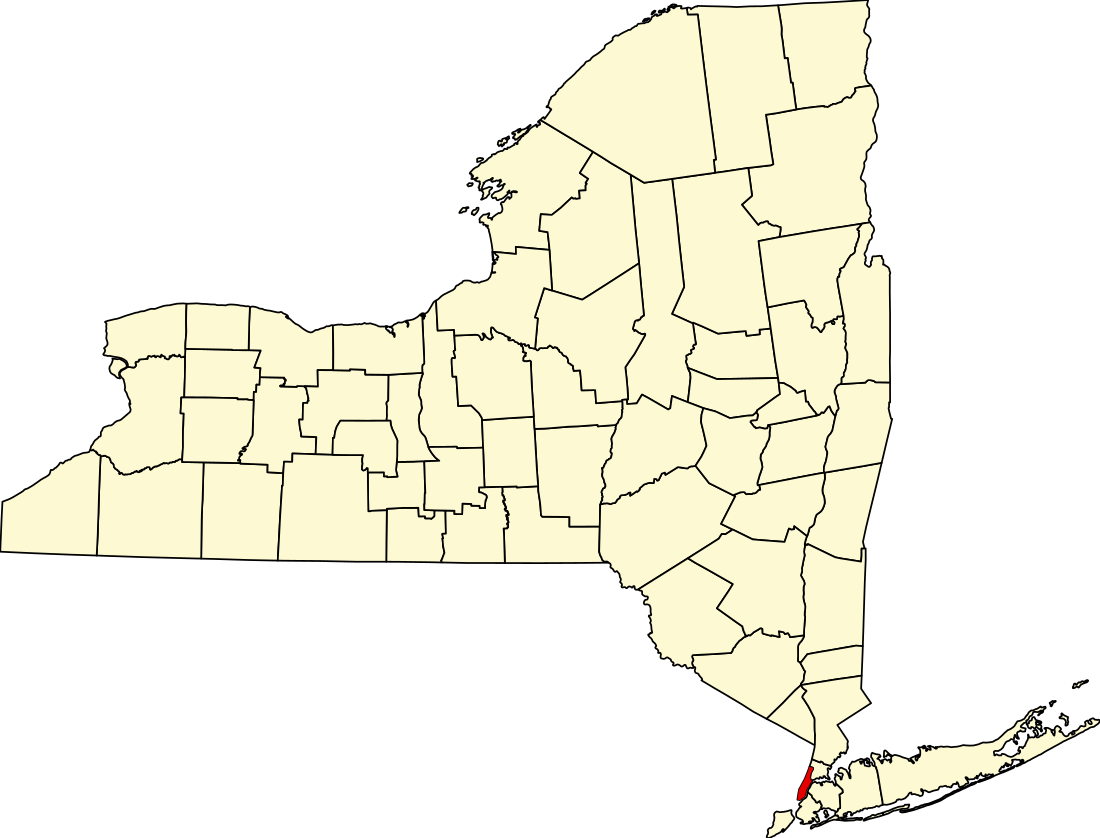



New York
New York Wrongful Death Law: Statute, Damages & Survival Actions
New York gives families two years from the date of death to file a wrongful death claim. But New York limits damages to pecuniary (financial) losses only — making it one of the most restrictive states for wrongful death recovery.
By 411 Press Legal Desk10 min read
A 42-year-old father of three is killed when a concrete facade panel falls from the 14th floor of a Manhattan building and strikes him on the sidewalk below. The building owner received a structural inspection report seven months earlier identifying the facade as deteriorating and recommending immediate repair. The repair was never scheduled.
His family files a wrongful death claim. And here they encounter a harsh reality of New York law: despite being one of the most populous and litigated states in the country, New York has one of the most restrictive wrongful death damage frameworks in the nation.
New York limits wrongful death damages to pecuniary (financial) losses only. The grief, loss of companionship, and emotional devastation that surviving family members experience are not recoverable in a New York wrongful death action. This sets New York apart from most other states — and from what many families expect when they file.
Understanding this limitation, and how to work within it, is critical for any family pursuing a wrongful death claim in New York.
Statute of Limitations
Two years from the date of death. Under EPTL § 5-4.1, a wrongful death action must be filed within two years of the decedent's death.
Medical malpractice exception: If the death resulted from medical malpractice, the deadline is two years and six months from the date of death.
Government entity claims: Claims against government entities require a Notice of Claim within 90 days of the death, and the lawsuit must be filed within one year and 90 days. This applies to claims against New York City, NYCHA, the MTA, state hospitals, and all other government entities.
Tolling exceptions: The statute may be tolled for infancy (until age 18) and for persons with mental incapacity. If the personal representative is not appointed until after the death, the statute is tolled during that period.
Who Can File
Only the personal representative of the decedent's estate may file a wrongful death lawsuit in New York. Individual family members — even the surviving spouse — cannot file on their own behalf.
The personal representative must be formally appointed by the Surrogate's Court:
- If the decedent had a will, the executor named in the will petitions for appointment.
- If the decedent died without a will (intestate), a family member (typically the surviving spouse, adult child, or parent) must petition to be appointed as administrator of the estate.
This process takes time. Families should begin the probate process promptly to avoid the statute of limitations running while waiting for the appointment.
Distributees — Who Benefits from the Recovery
While only the personal representative files the lawsuit, they do so on behalf of the decedent's distributees — the individuals who would inherit under New York's intestate succession laws (EPTL § 4-1.1). These typically include:
- Surviving spouse — receives the first $50,000 plus half the balance of the estate (if there are children), or the entire estate (if there are no children)
- Children — share the remainder after the spouse's share
- Parents — if there is no surviving spouse or children
- Siblings — if there are no surviving spouse, children, or parents
- Other heirs under the order of intestate succession
The Pecuniary Damages Limitation
New York's wrongful death statute explicitly limits recovery to "pecuniary injuries" — financial losses suffered by the distributees. Under EPTL § 5-4.3, damages are restricted to:
What You CAN Recover
- Loss of financial support — the income and financial contributions the decedent would have provided to the distributees
- Loss of parental guidance and nurturing — for minor children, this has been interpreted to include the economic value of parental services such as education, training, and guidance (Gonzalez v. NYCHA)
- Loss of services — the economic value of household services, caregiving, and other practical contributions the decedent provided
- Loss of inheritance — the assets the decedent would have accumulated and passed to heirs
- Medical expenses — between the injury and death (typically recovered through the estate claim)
- Funeral expenses — reasonable burial and funeral costs
- Conscious pain and suffering of the decedent — this is recoverable through the survival action (EPTL § 11-3.2), not the wrongful death claim itself. The estate recovers this on behalf of the decedent.
What You CANNOT Recover
- Grief, sorrow, and bereavement of the surviving family members
- Loss of companionship (as a standalone non-economic claim)
- Emotional distress of the survivors
- Loss of consortium by the surviving spouse (though the economic value of the spouse's services may be recovered)
Why This Matters
In most states, a jury can award damages for the survivors' grief, loss of companionship, and emotional devastation — often the largest component of a wrongful death award. In New York, these are excluded. A family that loses a beloved retired grandparent with no income may have limited wrongful death damages under New York law, even though their loss is devastating.
This is why the survival action is critically important in New York. The estate's claim for the decedent's conscious pain and suffering before death is often the largest component of the total recovery, because it is not limited to pecuniary losses.
Key New York Cases
Gonzalez v. New York City Housing Authority (N.Y. 1991)
The New York Court of Appeals expanded the definition of pecuniary loss to include the value of services that do not have a direct monetary equivalent. A 76-year-old grandmother who was murdered in her NYCHA apartment left two adult grandchildren she had raised. The court held that the grandmother's caregiving — counseling, shelter, meals — constituted compensable "pecuniary injuries" even though the services were not performed for pay. This case is the leading authority for expanding pecuniary damages beyond pure income replacement.
Liff v. Schildkrout (N.Y. 1980)
The New York Court of Appeals held that wrongful death damages must be based on pecuniary loss and cannot include compensation for grief, loss of society, or companionship. The court explicitly rejected the argument that New York's wrongful death statute should be interpreted to allow non-pecuniary damages, noting that any such change must come from the legislature.
Parilis v. Feinstein (N.Y. 1980)
The Court of Appeals addressed the damages standard for the loss of parental guidance, holding that the pecuniary value of a parent's guidance and training to minor children is recoverable. The court recognized that raising children has economic value, even when the parent was not employed outside the home, and that juries can assess this value.
Common Wrongful Death Scenarios in New York
Motor vehicle accidents — car, truck, motorcycle, pedestrian, and bicycle fatalities. New York City's dense traffic and the state's extensive highway system produce a significant volume of fatal accidents.
Medical malpractice — surgical errors, emergency room failures, misdiagnosis, birth injuries. New York is one of the most heavily litigated medical malpractice states. Additional procedural requirements include a certificate of merit from a qualified medical expert.
Construction accidents — New York Labor Law §§ 240 and 241 impose strict liability on property owners and general contractors for gravity-related injuries (falls, falling objects) at construction sites. This makes New York uniquely favorable for construction wrongful death claims — the owner and general contractor are liable regardless of fault.
Premises liability and negligent security — fatal injuries from dangerous property conditions or inadequate security. See our New York premises liability guide and New York negligent security guide.
Nursing home negligence — deaths resulting from inadequate care, medication errors, and neglect in residential facilities.
Available Damages
Wrongful Death Action (EPTL § 5-4.1)
- Loss of financial support — calculated based on the decedent's income, age, health, life expectancy, and the distributees' dependency
- Loss of parental guidance — for minor children (Gonzalez, Parilis)
- Loss of household services — the economic value of services the decedent provided
- Loss of inheritance — projected savings and asset accumulation
- Funeral expenses — reasonable costs
- Interest from the date of death — New York allows interest on wrongful death damages from the date of death, which can add significantly to the total award
Survival Action (EPTL § 11-3.2)
- Conscious pain and suffering — the physical and emotional suffering the decedent experienced between the injury and death. This is often the single largest damages component in New York wrongful death cases.
- Medical expenses incurred between the injury and death
- Lost earnings from the date of injury to the date of death
Punitive Damages
Punitive damages are not available in the wrongful death action itself. However, they may be recoverable in the survival action in cases of particularly egregious conduct. Courts evaluate punitive damages on a case-by-case basis.
No Statutory Caps
New York does not impose statutory caps on wrongful death damages or survival action damages (except in cases against government entities, which may be subject to specific limits).
Practical Next Steps
If a family member died due to someone else's negligence in New York:
Act immediately on the deadlines. The two-year wrongful death statute of limitations is only part of the picture. If the responsible party is a government entity, the 90-day Notice of Claim deadline is the real emergency. Begin the process within days of the death.
Begin the probate process. A personal representative must be appointed before the wrongful death lawsuit can be filed. Petition the Surrogate's Court for appointment of an executor (if there is a will) or an administrator (if there is no will).
Pursue both the wrongful death claim and the survival action. Because New York's wrongful death damages are limited to pecuniary losses, the survival action for the decedent's conscious pain and suffering is essential to achieving full compensation. Both claims should be pursued.
Document the decedent's financial contributions. Under the pecuniary damages standard, evidence of the decedent's income, spending patterns, financial support to family members, services provided (childcare, household tasks, caregiving), and projected future earnings is critical.
Preserve evidence of conscious pain and suffering. Medical records, witness accounts, and first responder testimony documenting what the decedent experienced between the injury and death are essential for the survival action.
Do not communicate with the defendant's insurance company. Provide no statements without an attorney present.
Consult a New York wrongful death attorney. The pecuniary damages limitation, the survival action strategy, the personal representative requirement, and (in construction cases) the Labor Law strict liability framework all require experienced counsel. An attorney can maximize recovery within New York's unique constraints.
Related New York Guides
- New York Negligent Security Law — when a security failure contributes to a death
- New York Premises Liability Law — when a property condition causes a fatal injury
Last updated: May 27, 2026. Consult a New York attorney for advice specific to your situation.
Related coverage